Kleverio Prospector: How We Built an Evidence-First Sales Engine
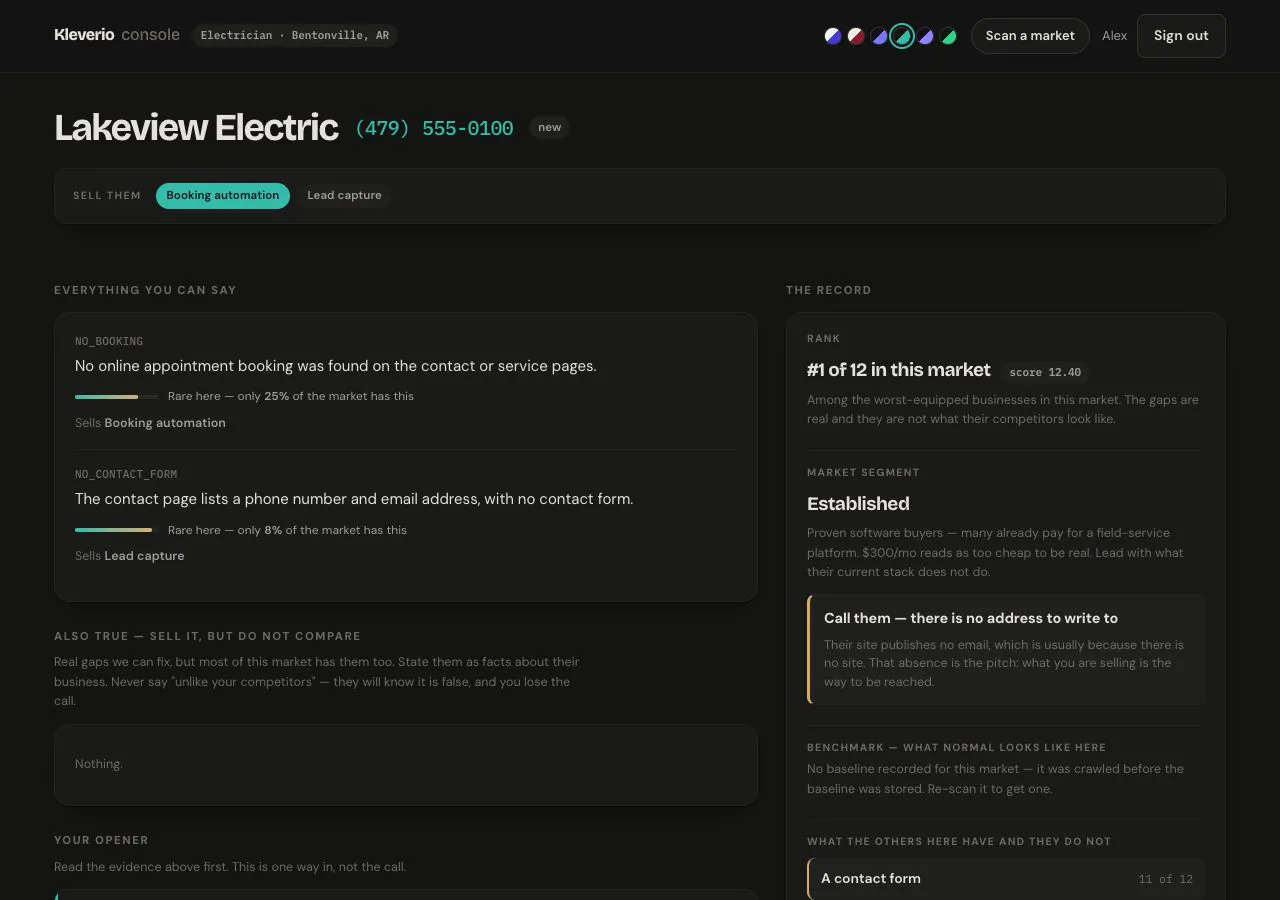
A list of businesses is easy to produce. A list that tells a salesperson who deserves attention, what to say, and why that statement is defensible is a much harder product. Kleverio Prospector was built to close that gap.
It brings business research, website assessment, prioritization, caller preparation and tailored demo pages into one workflow. The aim is practical: help a person start a useful conversation with a local business, carrying a specific observation rather than a generic pitch.
From market research to a prepared conversation
Six connected steps turn source information into a next step a person can act on.
Choose a market
Define the trade and location to research.
Collect observations
Bring together business records and website reads.
Prioritize supported gaps
Assess evidence and compare with local peers.
Prepare the caller packet
Put findings, an opener and the offer in one place.
Show a tailored demo
Make the proposed experience tangible for the owner.
Call and follow up
A person makes the call and records the outcome.
The problem: more records do not make a better sales queue
Local business data can tell you a company’s name, phone number, review count and website. It rarely tells you whether the next call should lead with online booking, a simpler enquiry flow, or a more basic website conversation.
A missing website also does not automatically make a business an attractive prospect. Review volume, local context and the nature of the gap matter. An established company with steady customer activity and a specific friction point may be a better fit than a business that simply lacks a URL.
We needed a system that could assemble that context and keep it usable. A caller should be able to inspect the supporting evidence, understand the suggested offer and record what happened without rebuilding the research in another tool.
From source records to specific observations
Prospector starts with a market: a trade and a location. Source records provide the business details, and website reads add observations about capabilities such as contact forms, quote requests and online booking.
Those observations pass through detectors with explicit evidence and confirmation state. Peer comparisons use the market’s defined cohort, so a statement about what is common locally has a population behind it.
Prioritization follows explicit scoring rules. The score helps organize attention; the evidence determines which claims may be used. A high score cannot turn an uncertain observation into a fact a caller should repeat.
The central design rule: finding something in a database, ranking it, and saying it to a business owner are separate decisions. Each needs its own justification.
A caller’s packet, rather than another spreadsheet
The caller console brings the prospect record, evidence, suggested opener and relevant offer together. It supports assignments and call outcomes, keeping the working history attached to the business.
Owner-facing artifacts have a different job. Audits explain observations to the owner, while email drafts turn supplied facts into a follow-up a person can review. The wording must remain truthful after it leaves the internal research screen.
That distinction matters. “This needs checking” is useful coaching for a caller, but it cannot quietly become “you do not have this” in an audit. We review complete rendered outputs as well as detector results, because a correct boolean can still produce a misleading sentence.
Making the proposed improvement tangible
Generated demo pages give a business a concrete view of the proposed experience. A shared layout adapts to the trade and uses the business’s available details, while confirmed findings help determine which modules the demo presents.
Where enabled and successfully provisioned, demos can mount a real front desk and demo booking. Live behavior depends on recorded setup state and expiry; booking also depends on the available hours and time zone. A page does not promise a live capability merely because it contains a button.
The demo is a demonstration, not an installation on the prospect’s own website. Keeping that boundary visible makes the artifact useful in a sales conversation without pretending the work has already been delivered.
What the build delivered
The result is a connected preparation workflow: market research becomes stored observations; supported findings become a prioritized queue; the queue opens into evidence, caller guidance and shareable artifacts.
We also built a way to test whether changes preserve that trust. Frozen observations guard detector behavior, and database and route tests exercise what reaches the console and artifacts. The checks do not make every website readable or every finding correct. They make regressions and unsupported conclusions easier to expose.
The product remains human-led. It prepares the research and the next step; people decide whom to contact, make the call and judge whether there is a fit.
Want research that leads to a better conversation?
Kleverio builds practical systems that connect data, operational decisions and the work people actually need to do. If your team has plenty of records but too little usable context, we can help design the workflow around the evidence.